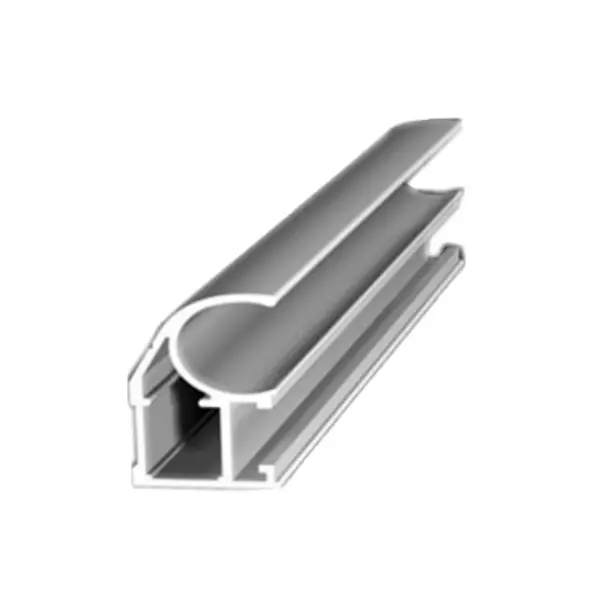
An extrusion profile is a two-dimensional drawing with three-dimensional consequences. This guide covers the design decisions that make custom aluminum profiles — heatsinks, enclosures, pipes and sections to design — economical to produce and pleasant to use.
Extrusion pushes aluminum through a die whose opening is your profile's cross-section, so the section drawing is the product. Every feature in that section — every fin, rib, channel and boss — exists along the profile's entire length. That is extrusion's magic (complex functionality at no per-metre extra cost) and its discipline (a feature needed once, at one end, still runs the full length unless machining removes it). Good extrusion design therefore starts by asking what must be constant along the length, and hands everything else to cutting and CNC work afterwards.
This factory's extrusion range is built on exactly that model: custom aluminum extrusion according to your design, then cut, machined and finished in-house. The design advice below assumes that partnership — profile for the constant geometry, machining for the local geometry.
Extruded sections fall into families. Solid sections (no enclosed voids) use the simplest, most economical dies and cover angles, channels, bars and finned heatsink profiles. Semi-hollow sections nearly enclose a void; hollow sections fully enclose one or more voids — tubes, and the box sections that make extruded enclosures work — and need more complex dies with mandrels. Each step up in hollowness buys function (enclosed channels, lighter weight, slide-together housings) at tooling complexity.
The design guidance is to enclose only what the function requires. A channel that can be open should stay open; a tube that must be a pressure or cosmetic boundary earns its hollow die. When you send a section, the review will name its family and flag any feature that pushes the die a class higher than the function needs.
Extrusion metal flows most happily through a section of even wall thickness and reasonable symmetry. Wildly varying walls — a massive boss beside a thin fin — make the tongue of the die deflect, the profile twist, and straightness a fight. Designers help production enormously by keeping walls as uniform as the function allows, transitions gradual, and the section balanced around its centre where possible.
Heatsinks are the classic test: tall thin fins beside a thick base are an inherently uneven section, yet they are a named product family here — custom aluminum 6061 6063 heatsinks — because the design compromises are well understood: fin proportions kept sensible, base thickness doing the spreading work, and the finish (anodized, in the range's second heatsink product) planned with the geometry. If your thermal design calls for aggressive fins, send it early; fin geometry is a conversation, not a rejection.
Extrusion is a forming process, and its natural variation is wider than machining's. Profiles are specified with commercial straightness and twist expectations, and cut lengths vary more than machined lengths unless parts are finish-machined. The practical pattern is hybrid: extrude the section, then let CNC machining own the dimensions that must be exact — mounting faces, hole patterns, end features. Designing the part so its critical dimensions fall on machined features, rather than demanding extrusion hold them, is the single most cost-effective habit in profile design.
Alloy choice between the range's two grades, 6061 and 6063, also belongs in this conversation: the review will discuss the application's strength, finish and section complexity against both, with the grade named on the final quotation rather than assumed.
Many profiles are anodized — the range lists an anodized heatsink — and anodizing rewards sections that drain and rack well and punishes sharp external corners that burnish bright. If the profile is a visible architectural or product surface, say which faces are cosmetic; profile handling and packing protect named faces differently from anonymous ones. Powder coating is the other house option for profiles that need colour and toughness over fine surface detail.
Finally, design for the cut list: profile economics improve when finished lengths nest efficiently in the supplied lengths, and when end machining is grouped rather than scattered. A five-minute conversation about your length schedule at quotation time regularly saves more than a hard negotiation on the per-metre price. Send sections via the contact form — section review is free, and it is where extrusion programmes are won.
Profiles are remembered by their ends: the cut face, the end cap, the last 20 mm where users touch the product. Decide how each end is finished — sawn, milled, capped, closed by a mating part — and put it on the drawing. End treatment is cheap to specify and disproportionately visible, and it is the detail most often left to improvisation when a profile programme is rushed.
Tell us the material grade, quantity and finish you need for your project. Our engineers review every drawing for die casting, machining or stamping feasibility before quoting — no obligation.
Send Drawings for a DFM Review